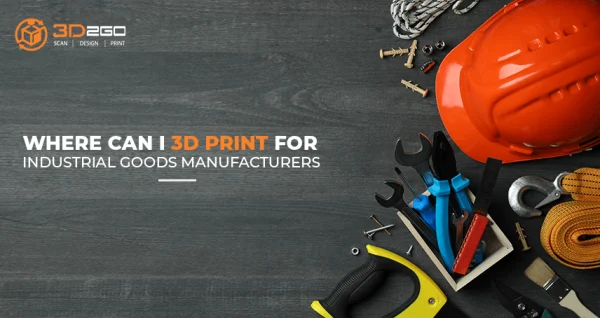
Where Can I 3D Print and Its Benefits for the Manufacturing Industry
3D printing is a definitive proof of Industrial Revolution 4.0. This is a classic example of physical and digital technologies integration. That results in half the time, twice the performance.
3D printing also caters to the surge of global demand for customized products and sustainable solutions. This innovation now moves way beyond prototyping as it also improves the supply chain.
3D Printing Fabrication Improves Supply Chain
For the manufacturing sector, fabrication is one of the expensive and time consuming factors in the time to market stage. However, the introduction of 3D printing minimizes or even eliminates these two factors. Leading to manufacturers to better leverage this innovation to cater to clients.
Advantages of 3D Printing Fabrication
- Reinvention of product conceptualization and design using 3D modelling software
- Faster turnaround time in production stage
- Minimize costs in product development and production costs
- Simplifies the logistics process
- Lowers carbon footprint
- Reduce number of parts in warehouses
- Decrease in inventory costs
Improvements in the supply chain is one of the biggest benefits of 3D printing in manufacturing. As AM can increase its mobility, flexibility, and ability. Which can reduce waste and costs in the long run.
Only print what you need is the working philosophy in 3D printing fabrication. As this allows manufacturers a quick yet efficient product fabrication and prototyping.
3D CAD software allows design correction through simple tweaks and print instantly. This saves time and costs in the designing and prototyping stage. This is also best for low volume production within a short time frame.
Key Benefits of 3D Printing Fabrication for Industrial Goods
Spare parts production and prototyping are the major benefits of 3D printing fabrication when it comes to industrial goods. But it also revolutionizes hard tooling like moulds for injection moulding and die casting.
CNC milling is the traditional way of producing such moulds. Which most of the time has to undergo several iterations before the desired product achievement. These changes could take weeks and months. Not to mention, expensive and at considerable material waste.
3D printing fabrication eliminates these at significant numbers. At the same time it offers ergonomic moulds, lightweight components, and cost-effectiveness.
Top Materials for Industrial 3D Printing Fabrication
| Material | Advantages | Disadvantages |
| Nylon | One of the toughest plastic material and cheapest
Has excellent strength to flexibility ratio Well -known 3D printing filament because of its flexibility, durability, low friction, and corrosion resistance Suitable for complex and delicate geometries Works best with FDM 3D printers Good for coloring or dye post processing |
Should be kept dry
Has the tendency to shrink during cooling which may result to less precise prints |
| ABS | Generally used for household or personal 3D printing purposes
One of the most accessible and cheap 3D printing filament Longer lifespan compared to Nylon Perfect for manufactures and engineers who wants high-quality prototype production |
Requires heated bed for printing
Has high melting point and may experience warping if cooled while printing This is a non-biodegradable toxic material and releases toxic fumes at high temperature |
| Resin | For castable resin, tough resins, and flexible resins
Has low shrinkage percentage Has high chemical resistance This material is rigid and delicate |
Expensive
Also expires when not used for a long time Exposure to high temperature can cause premature polymerization |
| Gold and Silver | Sturdy materials in powder form
This is for DMLS (Direct Metal Laser Sintering) or SLM process for 3D printing Has electrical conductance Heat Proof |
Expensive
Difficult to work with due to high reflectivity and high thermal conductivity Extremely high temperature is needed to 3D print products using these materials thus not compatible with regular FDM 3D printers |
| Stainless Steel | Perfect for fusion or laser sintering like DMLS or SLM technologies
Perfect for jigs and fixtures like bolts Performs well in high strength applications Has strong resistance against corrosion Has high ductility |
It takes much longer time to 3D print products
Expensive Printing size is limited |
| Ceramics | Newest material in 3D printing
Generally used in binder jetting technology like SLA (Stereolithography) and DLP (Digital Light Processing) More durable than metal and plastic as it can resist warping due to extreme heat and pressure High precision for smooth and glossy surfaces Resistant to acid and heat Has wide range of color |
Requires great amount of temperature to melt
Not suitable for glazing and kilning processes Not for object with enclosed of interlocking parts Not ideal for piece assembly process |
In the Philippines for places to 3D print, different providers use different 3D printers thus use different materials or filaments. The most common in the country is ABS, PLA, and Nylon. But some 3D printing services offer other materials as well based on your preference.
3D Printing Service Near Me? 3D2GO Is Your Best Choice
We are the pioneer of 3D printing services in the Philippines. We serve various clients in the manufacturing and industrial sector. 3D2GO has the best 3D printers and filaments that works best for your fabrication and 3D prototyping needs.
We also offer 3D scanning, 3D designing, and 3D reverse engineering services. Contact us today and let’s start your projects right away!